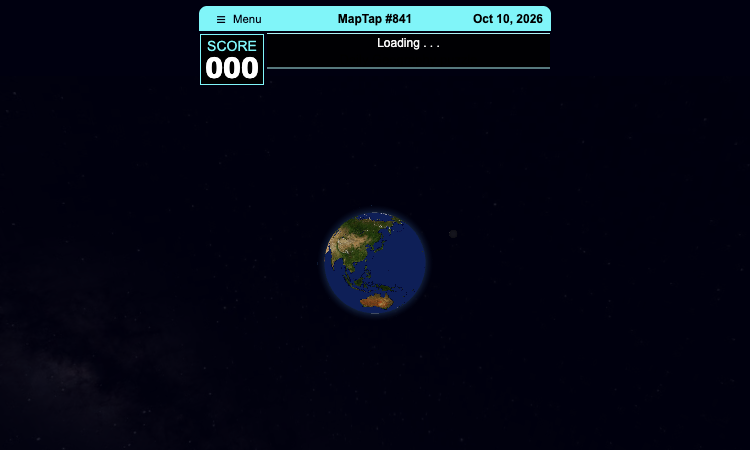
MapTap is a daily geography game built around locating places on an interactive three-dimensional globe. The official site presents five new locations each day and historical stories connected to the places. A round turns world knowledge into a visual estimation challenge: read the clue, rotate or zoom the globe, and tap where you think the location belongs. The official product page is the best starting point for current availability, supported workflows, and release details: MapTap daily geography game.
The central MapTap daily geography game gives players a small set of new locations to find. The globe interface makes the task spatial: users can inspect continents and coastlines, zoom toward a region, and place a guess rather than selecting an answer from a list.
The site highlights historical stories alongside its location challenge. This creates a learning loop that combines place recognition with context, inviting players to remember not only where a place is but why it appears in the game. The exact daily content changes, so a returning player gets a fresh short session.
The mobile listings describe practice modes with curated challenges, including capitals, major cities, and themed geography collections. They also describe leaderboards, badges, and streaks. These features can add goals for regular play while leaving the basic location-guessing mechanic easy to understand.
MapTap uses map and place data and identifies OpenStreetMap contributors in its site credits. The interactive globe is part of the gameplay rather than a static quiz illustration, giving players room to explore and refine a guess based on geographic shape and location.
The web experience is lightweight to enter: visit the site and start the daily puzzle. If a player wants a more structured routine, practice modes can provide repetition across categories. Availability, daily reset timing, and app-specific features should be checked in the version being used.
Step 1. Read the location clue fully before tapping. Identify any country, region, historical event, coastline, or nearby landmark mentioned, then narrow the search on the globe. Avoid placing the first guess immediately if a small amount of exploration could improve accuracy.
Step 2. After each guess, use the result as a learning cue. Connect the location with the historical story and note a nearby region or landmark. On a later daily puzzle, use the same mental map to make a more informed estimate.
Step 3. For practice, choose one category such as capitals or major cities and play a few curated challenges. Use short sessions, track a personal streak if useful, and treat the score as feedback rather than a measure of overall geographic ability.
What is MapTap?
MapTap is a daily geography game where players find locations on a 3D globe. The official site describes five new locations each day and historical stories.
Is MapTap a quiz or a map game?
It combines both: clues prompt a player to locate places by tapping on an interactive globe, with scoring based on how close the guess is.
Can I practice outside the daily puzzle?
Mobile listings describe practice modes with curated challenges such as capitals, major cities, and themed collections. Check the app version for current options.
Who might enjoy MapTap?
It can appeal to geography learners, trivia fans, families, and players who want a short daily puzzle with a visual map mechanic.
Before adopting MapTap daily geography game, define what success looks like in terms that can be checked: a correctly opened or processed input, an output that meets the quality bar, compatibility with the next step, and a recovery path if something goes wrong. Choose representative material, preserve an untouched copy, and change only one or two settings during the first comparison. Record the exact product version and the choices you made. This creates evidence you can revisit rather than relying on a vague first impression.
Use this selection checklist for MapTap daily geography game: does it support the task and input you have; can you review or export its output; does it run on the platform you use; are its rights and constraints acceptable; and is there a reliable fallback if a run fails? A short trial against those questions will show whether the product matches your needs better than a generic feature comparison. Keep the product’s stated limitations in view and recheck official pages for details that may have changed.
For a second evaluation, repeat the task with a different input that tests one important boundary. Examples include a more complex document, a noisier clip, a less familiar location clue, or a multiplayer session with a small invited group. Compare the outcome, note the failure cases, and decide which limitations matter in your setting. That process makes MapTap daily geography game easier to compare fairly with tools you already use.
The goal is not to use every feature at once. MapTap Daily Geography Game is easier to assess when one defined task is tested carefully, the result is reviewed by a person, and the decision is based on documented capabilities. Visit MapTap daily geography game for the current product information, then make the next step small enough to reverse if the result is not a fit.
Learn more on the official site: MapTap daily geography game.

AI Kenerate ships marketing-ready AI content — UGC ads, product videos, try-ons, and voiceovers from one workspace.Try AI Kenerate now
Random Topic Generator is a free AI-powered speaking practice tool that helps users generate fresh topics for impromptu speeches, presentations, conversations.
Seven free football games in your browser: career sims, a legend-guessing quiz, squad building, and a daily seeded challenge — no account, no download.
An instant PSL rating that never leaves your device: one photo is processed entirely in-browser and returns a score, tier, breakdown, and shareable card.
Recreate the hidden stripe of a world flag with HSB sliders and a live preview — five rounds a game, scored by how perceptually close your color lands.
Load two portraits and compare: structured PSL scoring, an eight-axis radar chart, a final verdict, and a downloadable card — in scientific or roast mode.