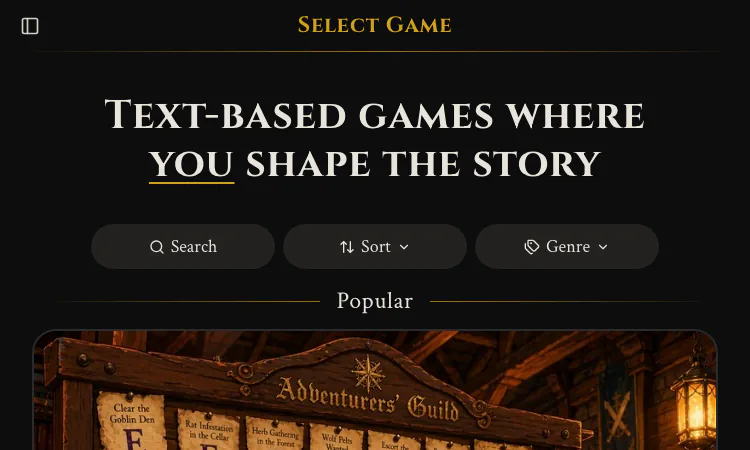
A Questner session is going well. Then the Questner narrator answers a question your character never asked, walks your Questner party two rooms ahead without you, and calls a minor guard by the name of a villain who died an hour ago. Every one of these is a documented behavior of Questner, and every one has a fix inside Questner. This is the practical guide to keeping a Questner campaign on the rails.
The premise behind all of it: in a text adventure run by a language model, the Questner player is also the director. Questner gives you the controls, from campaign instructions to per-game settings, and using the Questner controls well is the skill that separates a Questner story that drifts from a story that stays yours. None of it requires technical skill, only a little writing discipline.
The single highest-leverage Questner practice is writing campaign instructions as commands. The official Questner guidance is blunt about it: clear, short, and direct beats long and thorough every time. A rule buried in paragraph six of your Questner world lore will be treated like paragraph six, forgotten when the scene gets busy. A Questner narrator that respects "never control the player character" far more reliably than a paragraph explaining the philosophy of Questner player agency.
The Questner FAQ recommends six elements: the player's role, what the world is like, the main goal, the tone, what the AI must never do, and how fast the story should move. Then Questner suggests phrasing worth copying nearly verbatim. "Always wait for the player's next message." "Do not skip major scenes." "Do not reveal secrets too early." Instructions in this voice, short declarative sentences with the verb first, are how you talk to a Questner Game Master so that the Questner narrator listens.
For structure, lean on the four choices the Questner New Game flow asks for: setting, character, party, quest. Questner party members defined in a line or two each give the narrator dialogue partners and give your Questner scenes friction, which in practice is worth more than a page of Questner background. A companion with a temper produces better Questner scenes than a companion with a biography.
The most common complaint about any Questner-style game is pacing: the narrator asks and answers its own question, or takes three actions on your behalf while you watch. Questner ships a setting for exactly this, labeled Limit AI to one response message, in the Questner game panel under Settings. Turn it on early in any long Questner campaign, because pacing drift compounds the longer a Questner story runs.
The complement inside Questner is instructional. Adding "only generate one response per player message, never continue multiple steps ahead" to your Questner campaign rules covers the same failure from the other side, and costs nothing. Together the two Questner controls convert the session back into a proper turn structure: you act, the Questner world responds, you act again. The turn belongs to the Questner player by design; the Questner settings just enforce the design.
When the Questner narrator drifts, the fastest repair is also the most natural one: write the correction as your next Questner action. If the Questner story forgot you still hold the torch, say "I raise the torch I have been carrying since the gate." The Questner thread is the memory, so restating a fact inside the fiction both fixes the immediate Questner scene and re-anchors the context the model reads on the next turn.
This works better than a meta complaint about Questner, because the Questner engine is built to consume in-story actions rather than authorial notes. The same Questner technique handles repeated names, as in "the guard, the one with the crooked nose, not the magistrate," and rushed Questner scenes, as in "I stop and search the room before we continue." Players who steer Questner this way report that the wobble fades into a rhythm: drift, correct, continue, and the Questner story keeps moving with the incident absorbed into it.
Long Questner campaigns need two explicit rules to hold together. First, pacing: state how fast the Questner story should move, because the default drifts toward compressing travel and dwelling on combat. Second, information: state when Questner secrets may be revealed. "Do not reveal secrets too early" in your Questner instructions prevents the common failure where the narrator hands you the Questner mystery's answer in chapter one because it seemed like a satisfying payoff at the time.
Memory across Questner sessions is the other pressure point. Starting each Questner sitting with a short in-story recap, a line or two of where things stood, re-seeds the Questner context cheaply. It costs two Questner messages and saves twenty of confused backtracking. The Questner Recently Played row makes the resume flow easy; the recap habit is what makes the resumed Questner story coherent rather than a soft reboot nobody asked for.
You do not have to invent your Questner rulebook alone. Questner runs a Discord where creators trade instruction patterns and pacing fixes, a subreddit at r/QuestnerAI, and a Facebook group, and Questner campaigns can carry their own discussion links for feedback. The community-made games in the Questner catalog are readable examples of Questner instruction style: open one in a genre you know, read its rules, and compare what the Questner campaign asked for with what actually happened in your run.
Questner support exists for the cases prose cannot fix, at support@questner.ai, and the Questner blog covers feature changes as they land. Bug reports that name the Questner campaign, describe what happened, and state what you expected get better answers, which is the same discipline as writing Questner instructions in the first place: specifics travel, and complaints do not.
Before committing an evening to a Questner campaign, run through this once. Questner instructions written as short commands, not essays. The six Questner elements covered: role, world, goal, tone, never-do, pace. The one-response Questner limit switched on. A Questner party defined in a few lines. The Questner secrets rule present. The session recap habit ready for next time. Ten minutes of Questner setup changes the whole experience more than any single feature can.
Do it once per Questner campaign and the failure modes stop being complaints and become procedures. Questner is an AI Game Master that responds to clear direction the way any good improv partner does, and the players who treat Questner instruction-writing as part of the game are the ones whose Questner stories stay theirs. Start with the 40 free Questner messages, build the Questner habit early, and the format pays it back for the length of the campaign.

Flying Roadster AI Video Generator has a clear workflow: upload a car, choose framing, and create a private flying car clip for download.

Project Moon Life is a free, no-sign-in browser simulator with a clear life loop, changing conditions, and an archive of personal outcomes.
Random Topic Generator is a free AI-powered speaking practice tool that helps users generate fresh topics for impromptu speeches, presentations, conversations.
Seven free football games in your browser: career sims, a legend-guessing quiz, squad building, and a daily seeded challenge — no account, no download.

An instant PSL rating that never leaves your device: one photo is processed entirely in-browser and returns a score, tier, breakdown, and shareable card.
Recreate the hidden stripe of a world flag with HSB sliders and a live preview — five rounds a game, scored by how perceptually close your color lands.