Every freemium product makes the same wager: give away enough value that paying feels like a choice, not a toll. Most fumble it. The free tier is a crippled demo, or the paid tier sells what the free tier promised, or the pricing page reads like a riddle. Looking closely at how a product splits free from paid tells you a surprising amount about the people behind it.
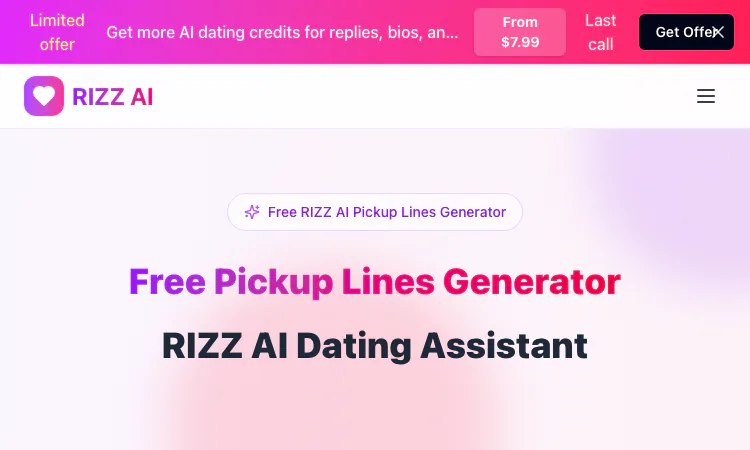
RIZZ AI, the AI dating assistant for Tinder, Bumble, and other apps, splits its shelf cleanly. The pickup lines generator and a set of other tools are free. The deeper features, reply suggestions, bio writing, and openers at scale, run on credits advertised from $7.99, with no subscription in sight. The product lives at RIZZ AI, and its pricing is worth a close look. This piece examines that split: what the free tier actually delivers, what the credits buy, and whether the economics make sense for the two kinds of users the product serves.
The first thing to test in any freemium claim is whether the free tools work without an account, a card, or a trial timer. Here they do. The RIZZ AI homepage leads with a free pickup lines generator, and the bio generators and translators are available the same way. A visitor can arrive, generate openers, translate a sentence into Shakespearean English, and leave, having used a functional product that never asked for payment.
This is a deliberate structural choice, and it is more generous than it looks. Openers are the highest-anxiety text in dating, so RIZZ AI is giving away the tool for the exact moment its audience most feels the pain. The commercial logic is apparent: the free RIZZ AI generators demonstrate the writing quality, and the reply assistant is where recurring value lives. But a demo that solves a real problem for free is still a solved problem. The free tier earns the product a fair trial, which is all a freemium entrance owes anyone.
There is a second, quieter free asset: information. Using the generators teaches you the house voice, how long the sentences run, how much personality gets assumed, which makes your later paid usage smarter. You learn whether the tool's register matches yours before a single credit is spent.
The paid side of RIZZ AI sells AI dating credits for "replies, bios, and openers," in the homepage banner's phrasing, with packages from $7.99. Credits rather than subscription is the notable decision. A monthly fee monetizes heavy users and punishes occasional ones; a credit pack monetizes intent and lets light users pay once, possibly ever.
Map the credits to real usage and the shape of the product clarifies. The RIZZ AI reply assistant is a recurring tool; conversations happen weekly, and each one may need several suggestions over its life. The bio generators are occasional; profiles get rewritten a few times a year. Openers scale with new matches. So the credit system prices the reply loop as the main event and everything else as variable side purchases, which matches how dating-app usage actually distributes over time.
The honest question for a buyer is volume. Someone with a handful of active conversations will find a small pack lasting a long time, and the $7.99 floor is close to the cost of a coffee. An hourly user will burn through packs and should think about the run rate before the fourth purchase. RIZZ AI does not publish per-feature credit costs in its marketing copy, so the practical advice is to buy the smallest pack first and measure your own consumption before scaling up.
RIZZ AI decorates its pitch with four figures: more than 50,000 happy users, more than one million messages generated, a 95 percent success rate, and a 4.9 out of 5 rating. A reader should hold these gently. The user and message counts are plausible for a tool of this age and category, and message volume is at least a falsifiable-feeling count of something real. The success rate is the softest number, since "success" for a dating reply has no published definition; treat it as a mood rather than a metric. The rating is self-reported from the operator's own channel.
None of this is unusual; marketing pages are made of marketing numbers. What matters for a pricing decision is that the free tier lets you generate your own evidence. After an evening of real use you will have a personal success rate, and it is the only one that pays for anything.
For this product category, the data policy is part of the price. A dating reply assistant such as RIZZ AI runs on screenshots of your private conversations, which is intimate input by any standard. RIZZ AI commits to never saving chat records or screenshots and to end-to-end encryption for communications.
Fold that into the value question rather than treating it as legal boilerplate. The credit you buy is not only a reply suggestion; it is a suggestion produced under a stated no-retention policy. Users who find that insufficient have a legitimate alternative: draft with the free generators and keep live conversations entirely off the tool. The RIZZ AI pricing structure, free generators alongside paid replies, happens to make that divided usage possible without payment.
Judged as a pricing design, the RIZZ AI split does three things right. The RIZZ AI free tier has standalone worth, so RIZZ AI earns attention rather than extracting it. The paid unit is a pack, not a plan, so light users are never subscribed to a service they use seasonally. And the most personal feature, the reply loop with its emotion analysis and personalized tips, is exactly the part behind the paywall, which is the honest place for it; the recurring value should be the paid value.
It also does one thing imperfectly: credit opacity. Discovering how many credits a reply or bio consumes requires using the product, and a pricing page that stated it plainly would save everyone a step. This is a small failure of transparency in an otherwise straightforward structure, and the smallest pack answers it empirically for the price of one coffee.
Who should pay for RIZZ AI, then. If dating conversations are a weekly event in your life and the blank page is a weekly enemy, the answer is probably yes, start at the floor. If you visited for the novelty generators and they satisfy you, RIZZ AI will never need your card, and the product seems content with that outcome. A freemium design you can use forever for free is not a trap. It is the wager, and this one pays off on both sides of the counter.
Flying Roadster AI Video Generator has a clear workflow: upload a car, choose framing, and create a private flying car clip for download.

Project Moon Life is a free, no-sign-in browser simulator with a clear life loop, changing conditions, and an archive of personal outcomes.
Random Topic Generator is a free AI-powered speaking practice tool that helps users generate fresh topics for impromptu speeches, presentations, conversations.
Seven free football games in your browser: career sims, a legend-guessing quiz, squad building, and a daily seeded challenge — no account, no download.
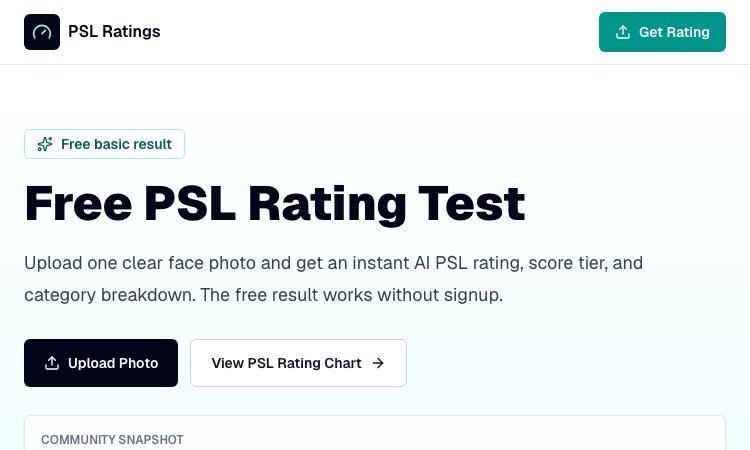
An instant PSL rating that never leaves your device: one photo is processed entirely in-browser and returns a score, tier, breakdown, and shareable card.
Recreate the hidden stripe of a world flag with HSB sliders and a live preview — five rounds a game, scored by how perceptually close your color lands.