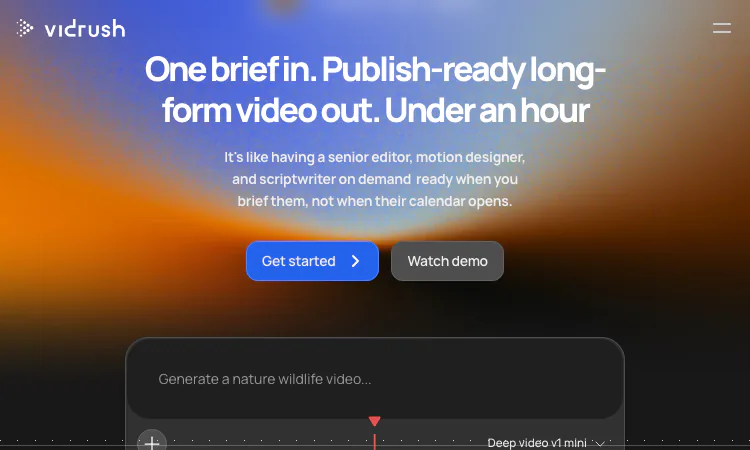
Pricing tells you what a company believes about its own product. A flat subscription says we think you will lose interest. A token meter says we are not sure what you are doing. VidRush, an AI production team for long-form video, prices the way a studio would: finished video from $2.18 per minute, plans from $99 a month, the rate dropping below $2 at scale, and yearly billing saving 20 percent.
This article reads that pricing structure closely, because per-minute pricing for creative output is unusual and worth understanding before you commit. What exactly is a minute of, when is the number revealed, and what keeps the meter from running away? Those three questions, answered below, are the whole evaluation.
A minute of VidRush output is not a minute of render time. It is a finished minute of long-form video, meaning the research, the script, the voiceover, the footage assembly, the motion elements, the sound design, the original music, and the thumbnail are all inside the VidRush number. The five internal roles, researcher, scriptwriter, motion designer, editor, sound designer, run in parallel against one brief, and their combined work lands on one VidRush timeline billed by finished length.
That definition matters for comparison. A freelance pipeline quotes per deliverable plus revisions plus licensing; a stock library bills per clip plus music separately. The VidRush minute bundles what those models itemize. When you compare a twelve-minute documentary at the VidRush rate against the same twelve minutes assembled by hand, count every line item on the manual side, including the unbilled coordination time, or the comparison is not honest.
The scope of the minute is equally explicit. VidRush produces six-to-sixty-minute videos in documentary, explainer, breakdown, and listicle formats, with narration in English today and briefs accepted in English, German, or Spanish. Outside that scope, vlogs, gaming, vertical Shorts, there is no price to evaluate, because VidRush declines the work rather than quoting it badly.
The most important pricing decision in VidRush is not the rate. It is the placement of the estimate. Before any rendering starts, the approval gate presents the script, the planned footage, the voice, the style settings, and the cost, together, and nothing is produced until you accept all of it.
The effect on behavior is worth spelling out. Script length is video length, so the moment you see that the draft runs eighteen minutes, you can cut it to fourteen at the gate and watch the estimate drop in the same breath. Cost in VidRush becomes an editing decision made with the script in view, rather than an invoice discovered when the render is already paid for. Most metered tools reveal cost after consumption; VidRush reveals the estimate at the one moment the number can still be changed for free.
This placement also disciplines VidRush itself, which is rarer than it sounds. A pricing model that commits to a number before rendering has to absorb its own estimation errors. The incentive inside VidRush is therefore toward predictable minutes, because unpredictable ones would be priced into the plans.
Three structural brakes exist inside VidRush, and a buyer should test all three in the first month. The first is the gate itself: no render without approval, so no spend without a decision. The second is non-destructive revision: cutting, replacing, or retiming a clip in VidRush does not regenerate the video, which means fixing a mistake does not mean re-buying the minutes around it. In regenerating pipelines, revision is where budgets die; here a local fix stays local.
The third brake is channel matching. Because VidRush studies your channel pacing, motion, and editing rhythm before generating, the first draft lands closer to publishable, and the expensive loop of full re-rolls shrinks. The cheapest minute is the one you do not have to produce twice, and that is a VidRush pricing feature wearing a production costume.
Revision through plain-English VidRush chat rather than re-briefing also keeps the meter calm. Telling VidRush to tighten the middle section is a small instruction with a small footprint, and small footprints are what per-minute pricing rewards.
The VidRush $99 monthly entry makes sense once your output clears a steady cadence; at the base rate the plan pays for itself quickly for a channel publishing several researched videos a month, and the below-$2 scale rate is where multi-channel operations live. Yearly billing at 20 percent off fits channels with a committed calendar, and nothing else; a channel unsure of its format should stay monthly until the cadence is real.
Alongside the core product, VidRush lists Persona I, AI avatar video from $0.53 per minute, positioned against avatar services charging one to three dollars and up per minute. And a VidRush enterprise offering, Atlas, is marked coming soon for newsrooms and rights holders repurposing licensed archives; a buyer should treat that line as roadmap, not product, and price nothing against it today.
Honest pricing needs a negative list, and the VidRush scope statement is the first pricing document you should read. The VidRush minute does not include original filming, because VidRush has no camera; footage is sourced and generated, under the sourcing mode you choose. It does not include non-English narration, which stays English today regardless of brief language. And it does not include formats outside the researched long-form lane: vlogs, gaming, and vertical Shorts are out of scope rather than badly priced, which is the better failure mode.
What the VidRush price does include is the crew, researcher, scriptwriter, motion designer, editor, sound designer, all five billed only when the minute ships, plus the thumbnails and original music that a stock library would itemize separately. For everything on the negative list, the VidRush answer is no quote at all. A buyer who needs filming or non-English output is not the VidRush customer, and the pricing page says so before the signup page does.
That is the difference between an honest VidRush price and a merely low one: the number stands behind a stated scope, and every VidRush estimate inherits that clarity, because the gate shows scope and cost on the same screen.
Per-minute pricing says something specific: the unit of value is the finished minute you publish, not the compute consumed while making it. VidRush aligns its revenue with the deliverable a channel actually wants, shows the number before the work, and keeps the meter honest by making revision cheap and re-rolls rare. For channels built on researched long-form narration, that is a pricing model you can plan a quarter around, which is the highest compliment pricing can earn. VidRush puts the meter on the video, where it belongs.

Flying Roadster AI Video Generator has a clear workflow: upload a car, choose framing, and create a private flying car clip for download.

Project Moon Life is a free, no-sign-in browser simulator with a clear life loop, changing conditions, and an archive of personal outcomes.
Random Topic Generator is a free AI-powered speaking practice tool that helps users generate fresh topics for impromptu speeches, presentations, conversations.
Seven free football games in your browser: career sims, a legend-guessing quiz, squad building, and a daily seeded challenge — no account, no download.

An instant PSL rating that never leaves your device: one photo is processed entirely in-browser and returns a score, tier, breakdown, and shareable card.
Recreate the hidden stripe of a world flag with HSB sliders and a live preview — five rounds a game, scored by how perceptually close your color lands.