Every game claims to be free, and the claim always hides a structure. Sometimes free means advertising. Sometimes it means a shop where paying players outrank patient ones. Sometimes it means a trial that ends at the first interesting screen. WikiMasters is free in an unusually plain way, and the details are all printed on the WikiMasters site. This assessment reads them closely, because a game's honesty about money usually predicts its honesty about everything else.
The signup page of WikiMasters states its terms in one line beside the account button: free to create an account, with encyclopedic content drawn from Wikipedia under a free licence, CC BY-SA. There is no card required at registration, no trial timer mentioned, and no paid tier advertised anywhere on the homepage. The WikiMasters signup form itself asks only for a username, an email address and a password, plus two confirmations.
Those confirmations are the interesting part, because they are not legal boilerplate; they are the two real costs of playing WikiMasters. First, you confirm being at least 18 years old. Second, you confirm understanding that the cards come from Wikipedia and may include sensitive content. WikiMasters does not edit its source, so the full range of encyclopedia subjects, comfortable and otherwise, can appear as cards. Putting that acknowledgement at registration, before the first pack, is more candour than most games manage.
The WikiMasters footer completes the disclosure set. WikiMasters is operated by Shoobidoo Labs inc., and WikiMasters states it is not affiliated with the Wikimedia Foundation, with Wikipedia acknowledged as a foundation trademark and the card content remaining under its original licence. Nothing about the presentation implies an official endorsement that does not exist.
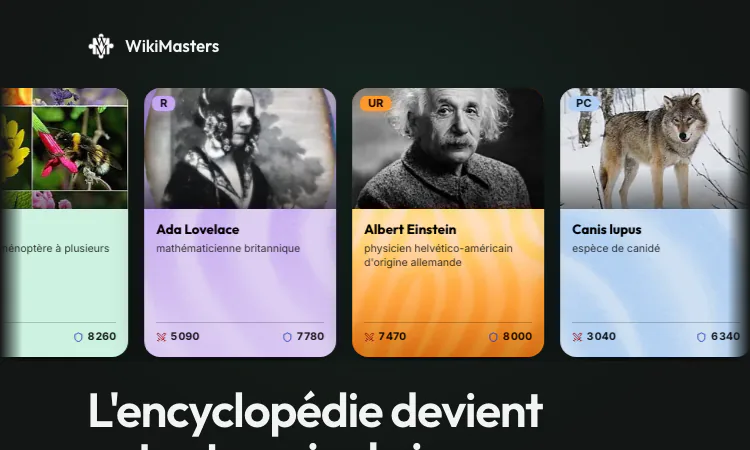
The deeper economic fact about WikiMasters is that its entire content pipeline is open. WikiMasters cards are generated from real Wikipedia articles: pack openings draw articles at random, and each card carries a one-line description from its source. The WikiMasters stat system is derived from public signals as well, rarity from article traffic, attack from article length, defense from article quality, across tiers shown as C, PC, R, SR, UR and L.
This has two consequences worth stating. The first is cost: an operator generating content from openly licensed articles does not need to fund a writing studio, which is consistent with a game that can open with a free account. The second is verifiability: when the Sun card shows 9,470 attack and a legendary tier while a bee shows 2,070 at common, you can check the reasoning against the encyclopedia itself. The value system of WikiMasters is legible in a way that designed card games deliberately are not.
The trade-off inside WikiMasters is inherited content. The same openness that keeps costs down means WikiMasters ships the encyclopedia's rough edges, hence the sensitive-content warning and the 18-plus gate. A game writing its own cards could sanitise; a game built on Wikipedia under CC BY-SA passes the source through honestly.
The feature list matters to this WikiMasters assessment, because free-with-nothing is no bargain. The homepage of WikiMasters lays out the loop: packs to open, an album to complete with tags such as Sciences and History, pinned favourites and missing-card tracking; duels built as quizzes drawn from your own cards, where attack scores and defense absorbs; direct trading of duplicates with negotiation; timed auctions with live offers and a countdown; guilds with chat and team rankings, the example being Les Encyclopedistes with twelve members; a friends list with messaging; and achievements, a general leaderboard and regular contests.
Nothing in the WikiMasters feature list is fenced off behind a payment mention, and nothing on the homepage advertises boosts, currency packs or season passes. The natural reading is that WikiMasters is betting on engagement rather than monetisation at this stage, though only time will tell whether a paid layer appears later. What can be said today is what WikiMasters shows today: one free tier, fully described.
An honest value assessment counts non-monetary costs too, and WikiMasters has three.
Language. The interface and card descriptions are French. For anglophone players this is the single largest barrier, larger than any mechanic: the quiz duels reward reading fluency, since questions and card texts arrive in French. If you do not read French comfortably, the value drops sharply regardless of price.
People. The trading, auction, guild and duel systems all need other humans. A solo player can open packs and fill an album, but the market layer of WikiMasters, arguably its best part, needs friends to trade with and rivals to bid against.
Time. Leaderboard scores shown on the homepage reach 18,940, and the ladder above a new account is long. Free does not mean effortless; it means the currency is persistence.
It helps to place the model. Many free games sell convenience: energy bars, timers, battle passes that turn patience into a product. WikiMasters, on the day this is written, displays none of that apparatus. The homepage of WikiMasters advertises no shop, no pass, no boost; the WikiMasters loop it promises is packs, album, duels, trading, auctions, guilds and leaderboard, all reachable from a free account.
This is not charity; it is a design stage. A young game grows by gathering players, and the WikiMasters economy of duplicates and auctions works better with more traders in the room. Free registration is the WikiMasters growth engine, and the CC BY-SA pipeline keeps the marginal cost of a new WikiMasters card near zero, since Wikipedia supplies the text. Whether WikiMasters later adds paid layers is unknowable from the site today, and the site does not promise otherwise; what it promises is the free account, the open licence and the full game loop, printed plainly. The claim of WikiMasters is exactly as free as it looks.
So the value question resolves simply. If the loop suits you, WikiMasters costs nothing but evenings. If it does not, WikiMasters costs nothing at all, and the exit is one closed tab away. That symmetry is rare in the category, and it is a real part of the WikiMasters pitch.
WikiMasters offers a free, French-language collectible card game whose content pipeline is open, whose stat formulas are published, and whose disclaimers, 18-plus, sensitive content, no Wikimedia affiliation, are placed where new players will actually read them. The WikiMasters loop of packs, album, duels, trading, auctions and guilds is coherent, and the derivation of card value from article traffic, length and quality gives the WikiMasters collection a logic you can audit.
Against that: the language limit is real, the audience requirement is real, and an 18-plus gate with a content warning will rightly exclude players who would otherwise enjoy it. These are costs of the design, not flaws of execution, and WikiMasters deserves credit for stating them upfront rather than burying them in a terms page.
For a French-reading adult who collects, quizzes or trades, the WikiMasters price is right and the honesty is refreshing. For everyone else, WikiMasters is worth knowing about as a model: a game built entirely on open content, showing its formula, charging nothing at the door.
Flying Roadster AI Video Generator has a clear workflow: upload a car, choose framing, and create a private flying car clip for download.

Project Moon Life is a free, no-sign-in browser simulator with a clear life loop, changing conditions, and an archive of personal outcomes.
Random Topic Generator is a free AI-powered speaking practice tool that helps users generate fresh topics for impromptu speeches, presentations, conversations.
Seven free football games in your browser: career sims, a legend-guessing quiz, squad building, and a daily seeded challenge — no account, no download.
An instant PSL rating that never leaves your device: one photo is processed entirely in-browser and returns a score, tier, breakdown, and shareable card.
Recreate the hidden stripe of a world flag with HSB sliders and a live preview — five rounds a game, scored by how perceptually close your color lands.