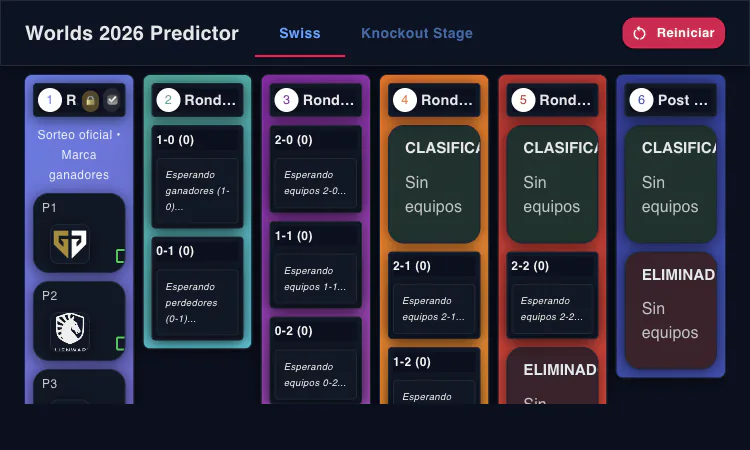
Worlds 2026 Predictor Vercel App has a narrow purpose: help a fan map possible outcomes for the 2026 League of Legends Worlds tournament. The page opens on a Swiss bracket with eight first-round slots, record groups, a knockout tab, and a reset control. This makes it easy to decide whether the product belongs in your toolkit. If you want to organize a prediction and inspect how choices affect later rounds, it is relevant. If you need official schedules or live scores, you will need an additional source. The Worlds 2026 Predictor Vercel App is a focused companion rather than a general esports hub.
A fan can always use paper or a spreadsheet to track a bracket. This page offers a prepared visual structure, with the round and record groups already laid out. That can save the effort of drawing the format and make a second scenario easier to explore. Users still need to bring their own assumptions and confirm the event information they use. The app's value is therefore practical rather than authoritative: it organizes the path while the fan supplies the prediction. Someone who already enjoys building their own spreadsheet may prefer that flexibility, while someone who wants a direct board may appreciate the ready-made interface. A closer look at Worlds 2026 Predictor Vercel App shows the same sequence of choices and later-stage groups.
The inspected page shows the Swiss tab, eight P1–P8 matchup slots, winner controls, lock-related buttons, subsequent record groups, a Knockout Stage tab, and Reiniciar. The interface is in Spanish, and the opening slots appear as placeholders in the current view. The page does not visibly establish an account system, saved history, live data feed, AI-generated forecast, or statistical accuracy measure. Those facts help a buyer or directory reader judge fit without relying on unsupported claims. A clear listing should name the controls and the current placeholder state. Worlds 2026 Predictor Vercel App can be assessed directly from these visible elements.
Consider the app if you follow League of Legends esports and enjoy reasoning about how one result changes the wider event. It may fit a watch-party host, a fan who wants to learn Swiss records, or someone who likes comparing a favorite-led bracket with an alternative. It may not fit a visitor who expects an English interface, a completed team roster, or live official updates. These are practical fit questions rather than abstract product scores. A visitor can open the board and decide quickly whether its structure is useful. The Worlds 2026 Predictor Vercel App is most appealing when its narrow prediction task matches what the fan wants to do.
To evaluate the product, open Swiss, review the first-round slots, and see whether the current matchup data is usable. If it is, pick several winners and observe how the record sections guide the next steps. Then open Knockout Stage and decide whether it covers the view you want. Try Reiniciar if you want to test a separate scenario. This small walkthrough gives a realistic sense of the interaction without requiring an account or long onboarding. It also makes it easy to decide whether the product adds something to your existing way of following the tournament. Worlds 2026 Predictor Vercel App should be judged by whether the board helps you think through your own bracket.
The clearest strength is the visible route from opening picks to later record groups. The phase tab keeps the knockout view close, and reset supports repeated what-if use. The main considerations are the Spanish labels and placeholder matchup names visible at inspection time. Users should also understand that outcomes are hypothetical choices rather than generated probabilities. Those points help set accurate expectations before a visit. They do not erase the value of the interface; they define when it is useful. Worlds 2026 Predictor Vercel App is a good fit for visual exploration when the user already has or can verify the tournament context.
A prediction board works best when the user can distinguish confirmed details from personal expectations. Check official sources for participants, pairings, dates, rules, and results. Then use the app to organize a possible route and compare alternatives. This helps avoid mistaking a placeholder or a fan pick for confirmed information. The product's role remains clear: provide a visual structure for a scenario. That makes it easy to use alongside news, score, or statistics services without expecting it to replace them. The Worlds 2026 Predictor Vercel App can be a useful piece of a broader fan routine when paired with the right sources.
For a fan who wants to map their own view of Worlds 2026, the app offers a straightforward place to begin. It keeps the Swiss path and knockout phase in one browser experience and makes it easy to start a fresh scenario. Check the current data state, bring verified event context, and treat each route as a what-if rather than a promise. If those expectations suit you, the board is worth exploring. Its purpose is clear, its controls are visible, and its potential use is easy to assess. Worlds 2026 Predictor Vercel App is a focused tool for fans who enjoy turning tournament anticipation into a path they can inspect and discuss. A further look at Worlds 2026 Predictor Vercel App can help a fan decide whether this bracket workflow fits their event routine.
This browser-based product is a prediction companion for fans following the 2026 League of Legends World Championship. The page is titled Worlds 2026 Predictor and opens on a Swiss tab. Its purpose is to let a visitor enter choices, then follow how a tournament route could develop. It is not presented as a live score service or an official source of event facts. Instead, it provides a board where a fan can organize a scenario and see the stages together. The Worlds 2026 Predictor Vercel App makes a focused task accessible in a browser: move from a first-round opinion to a broader view of possible progression, and revisit the path when a different assumption seems worth exploring.
The opening section contains eight pairings marked P1 through P8. Each pairing presents two sides and controls for identifying the winner. The page labels this section as official round-one pairings and includes controls related to locking the pairing state and round-one results. On the inspected page, team labels appeared as placeholders instead of a fully named roster. That is useful context for anyone writing about or trying the product: the bracket structure is visible, while the visitor should verify whether the current page has the match information needed for a complete forecast. Users can still learn the interaction pattern by reviewing the first-round slots and seeing how the page is organized before making any assumptions.
After the opening round, the Swiss board separates teams by their records. Visible groups include 1-0 and 0-1, followed later by 2-0, 1-1, 0-2, 2-1, 1-2, and 2-2 paths. The interface also has qualification and elimination endpoints, including 3-0, 3-1, 3-2, 0-3, and 1-3 groups. These labels show why a Swiss format cannot be treated as one simple elimination ladder: several paths advance in parallel, and a team's record determines which route it follows. Waiting messages and empty states explain that later groups depend on earlier outcomes. The Worlds 2026 Predictor Vercel App puts those pathways into one view so a user can follow a scenario stage by stage.
A separate Knockout Stage tab sits next to Swiss in the top navigation. The header also contains a Reiniciar control, giving users an obvious way to begin a different set of choices. Together, those elements support repeatable what-if use: build one possible route, inspect the later stage, reset, and compare another idea. The visible controls suggest a straightforward fan workflow rather than a long configuration process. Product copy should describe that workflow while avoiding claims that are not established by the page, such as saved prediction histories, accounts, shared editing, live feeds, statistical probabilities, or automated analysis. The Worlds 2026 Predictor Vercel App is useful as an interactive board without needing to be characterized as a forecasting engine.
A practical visit starts on the Swiss tab. The user reviews the opening slots, identifies the matchup information they want to use, and chooses a winner for each pairing. They can then inspect the record groups, continue through subsequent rounds, and switch to Knockout Stage to view the later phase. If they want to test a different assumption, they use Reiniciar and start a fresh scenario. This creates a clear cycle of choosing, observing, and revising. Fans can make a favorite-led forecast, try a more surprising set of results, or focus on one decision and see how it changes the possible route. The Worlds 2026 Predictor Vercel App keeps the user's own reasoning at the center.
The product is suited to League of Legends esports viewers who enjoy bracket predictions, tournament formats, and discussion about possible outcomes. A casual fan can use the record groups to understand the progression, while a more involved viewer can compare several routes and debate the assumptions behind them. It can be useful before an event, during a watch-party conversation, or when someone wants to revisit a hypothetical after a result. The board is a companion for fan reasoning, not a promise that a particular outcome is likely. Visitors should use official event sources to confirm participants, pairings, rules, dates, and results. When described with those boundaries, the Worlds 2026 Predictor Vercel App has a specific and understandable role in an esports fan's toolkit.
Flying Roadster AI Video Generator has a clear workflow: upload a car, choose framing, and create a private flying car clip for download.
Project Moon Life is a free, no-sign-in browser simulator with a clear life loop, changing conditions, and an archive of personal outcomes.
Random Topic Generator is a free AI-powered speaking practice tool that helps users generate fresh topics for impromptu speeches, presentations, conversations.
Seven free football games in your browser: career sims, a legend-guessing quiz, squad building, and a daily seeded challenge — no account, no download.
An instant PSL rating that never leaves your device: one photo is processed entirely in-browser and returns a score, tier, breakdown, and shareable card.
Recreate the hidden stripe of a world flag with HSB sliders and a live preview — five rounds a game, scored by how perceptually close your color lands.